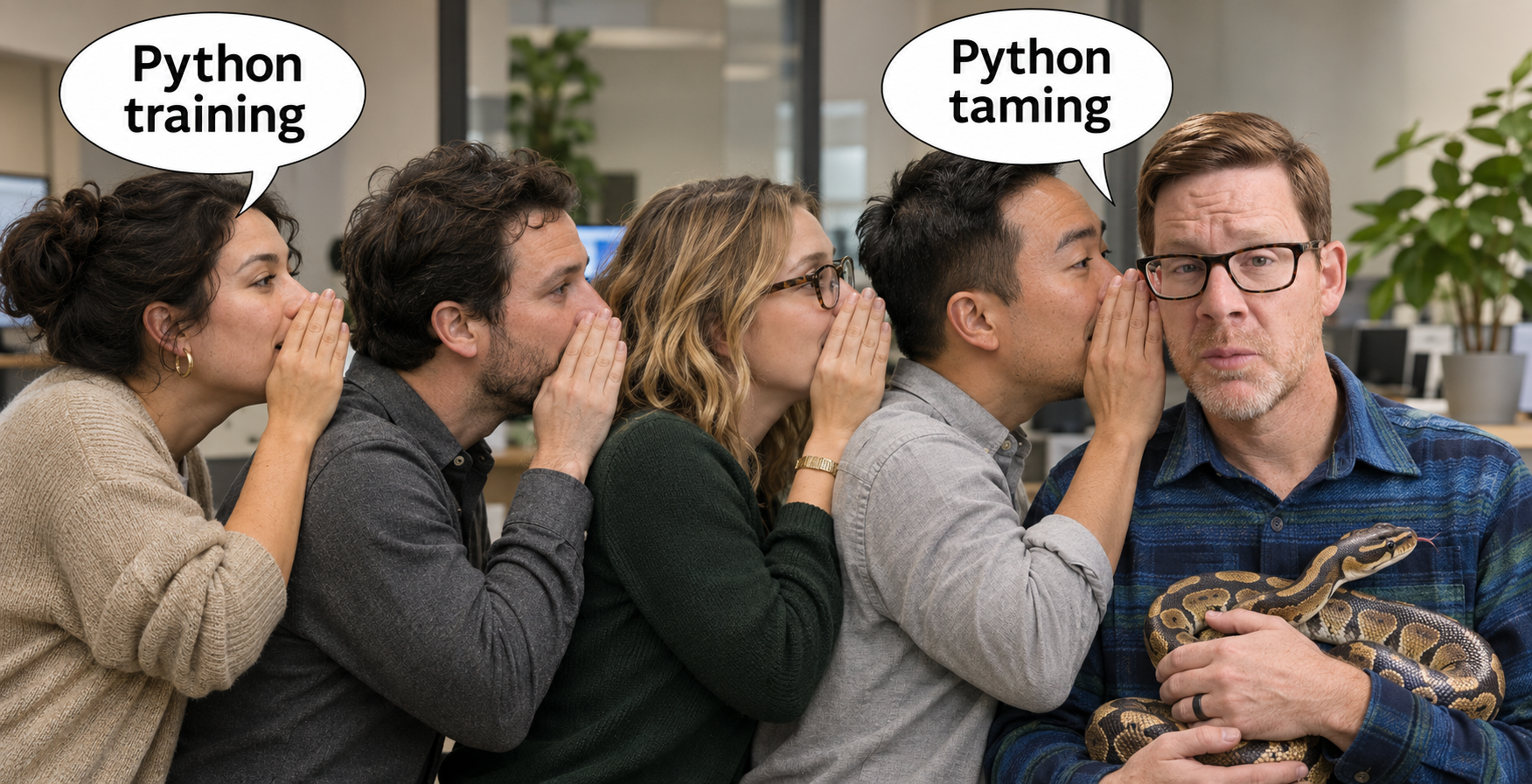
There are training companies that offer every course under the sun. What their clients might not realize is that those companies sometimes reach out to me to deliver the training.
You might end up with me as your instructor either way. But how we get there makes a difference.
I've taught through other providers, and it can be a decent experience. The frustrating part is getting an accurate picture of what the client needs before I walk into the classroom.
You probably know the game of telephone. Someone whispers a message to the next person in line. Each person passes it along. By the time the last person says it out loud, everyone is laughing at how much it has changed.
That's less funny when you've paid for training and taken your team away from their work.
Here's how it happens. A manager or learning director decides the team needs training. They discuss the requirements internally and send them to their training provider. The provider checks its catalog. If nothing fits, someone drafts an outline for a course that appears to cover the request.
Then they look for someone to teach it. Sometimes they go through another provider, who repeats the process before finding an instructor. By the time the request reaches me, I might have a course title, an outline, and a vague description of the audience. The people who could explain what the team actually needs are several conversations away.
A great instructor can deliver a great course from that outline. It still might be the wrong course for the team.
When you work directly with me, I can talk to your technical people. I can ask what they're doing, where they're struggling, and what they already know. We can work out what the training should cover together. If something is unclear, I can ask the person who knows the answer.
That conversation is part of preparing the course. It helps me choose the content, examples, and depth that will be useful to your team.
The providers sometimes tell me they're doing the hard work for me by managing the client relationship. I understand the appeal, but talking to the client is work I want to do. I care about delivering a great course, and those conversations give me a better chance of preparing one.
It's also much less frustrating than standing in front of a class and seeing confused faces because a requirement got mistranslated along the way. Finding that out in the classroom wastes everyone's time.
I understand why a company wants one provider for all its training. There's a catalog. There are boxes to check. Someone can say, "Yes, we offer that."
But who are those boxes serving? Does the arrangement help your colleagues get the training they need, or does it just make the purchasing process look easier?
If you want training in Python, data science, or AI, consider going directly to someone who teaches it. In my experience, you can often get a course that fits your team better and costs less. You may even get the same instructor the larger provider would have hired, with a chance to talk to them before the requirements have passed through five other people.
Before you book your next course, take five minutes to look for the people who actually deliver the training. Ask whether you can talk to the instructor about your team's needs.
If you'd like to have that conversation with me, get in touch.